Perhaps the most dazzling of all: quartered fields of black-and-gold bars (the Calvert arms) and red-and-white crosses (the Crossland arms). It is medieval heraldry turned state flag, bold and unmistakable. Maryland’s banner is sheer spectacle.
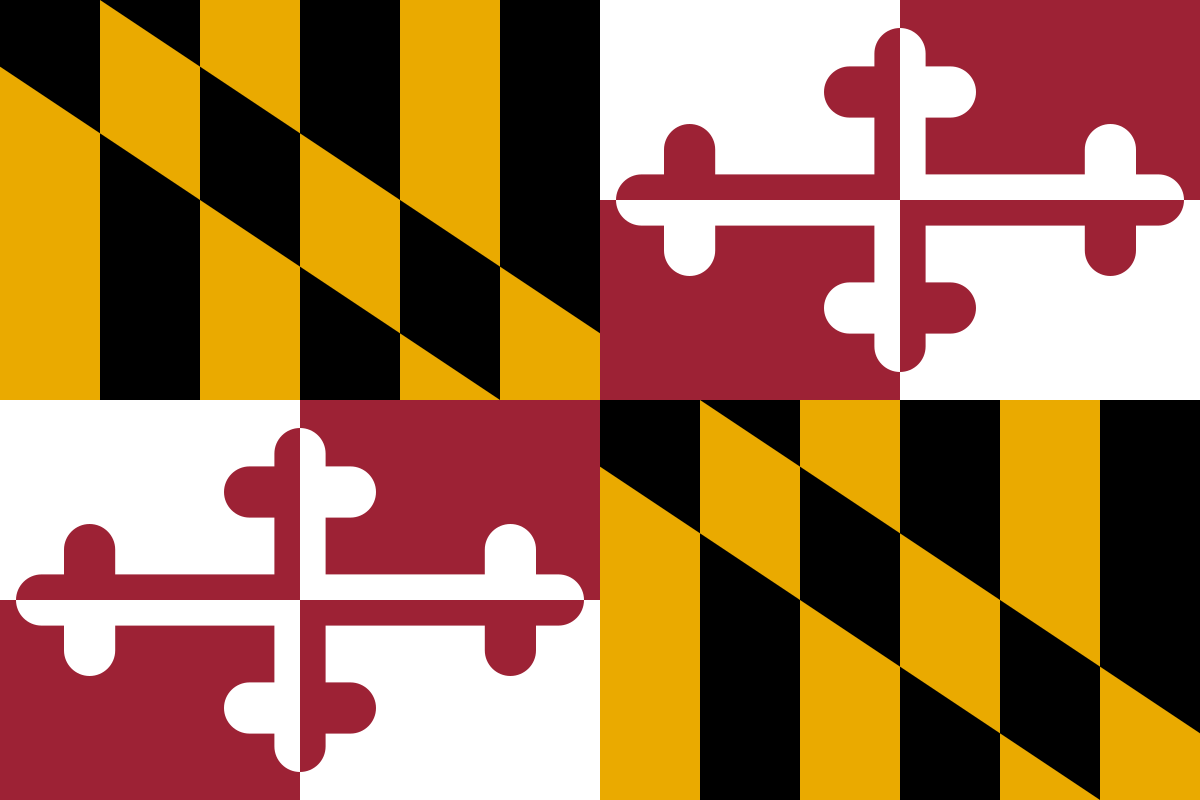
Quartered flag alternating black-gold and red-white designs.
Ratio: 2:3
Flag Statute
The 2024 Maryland General Provisions Code, § 7‑202 describes the state flag as follows: (a) The State flag is divided into quarters. (b) The first and fourth quarters are a paly of six pieces, or (gold) and sable (black), and a bend dexter (right diagonal band) counterchanged, so that they consist of six alternating gold and black vertical bars with a diagonal band on which the colors are reversed. (c) The second and third quarters are quartered argent (white) and gules (red), a cross bottony counterchanged, so that they consist of a quartered field of white and red, charged with a Greek cross that has arms terminating in trefoils and opposite coloring so that red is on the white quarters and white is on the red quarters, as represented on the escutcheon of the State seal.
Source: MD General Provisions Code, § 7‑202 (2024)
Flag at a Glance
- Designer
- Colonial heraldry
- Ratio
- 2:3
- Text on flag
- No
- Animals
- None listed
- Design type
- Heraldic banner
- Complexity
- 7/10
- Readability
- 8/10
- Seal-based design
- No
Colors used
Flag Symbolism
Calvert Black And Gold
Represents colonial founder George Calvert.
Crossland Red And White
Represents his maternal family.
What Makes This Flag Unique
A lot of state flags share common themes. This one stands out for a few reasons:
- Only state flag based entirely on English heraldry
- Only state flag to feature quartered family coats of arms
Praised and Criticised
Common praise
- Unique heraldic design
- High recognizability at distance
- Strong historical identity
Common criticism
- Busy appearance to unfamiliar viewers
- Unusual color combinations
Modern Discussion
Redesign debate: No
For Teachers & Students
Classroom-ready prompts, printables, and citation info for studying the Maryland state flag.
Subjects
Learning objectives
- Explain heraldry and family symbols.
- Compare Maryland’s unique design with other U.S. state flags.
Print this
Printable classroom handouts for this flag page.
Cite this page
Copy and paste a ready-made citation.
MLA
APA
Note: Citation formats can vary by school. These are common classroom defaults.
Seal Deep Dive
Calvert Arms
Represents the Calvert family, founders of the Maryland colony.
Attributes: Black and gold vertical bars with a diagonal band
Meaning: Authority, heritage, and proprietary rule
Crossland Arms
Represents the Crossland family lineage of the Calverts.
Attributes: Red and white cross bottony
Meaning: Faith, tradition, and family legacy
Quartering
The alternating quarters combine two family coats of arms.
Meaning: Unity and reconciliation after the Civil War
Historical Timeline
Maryland ratified the Constitution.
Flag officially adopted.
Fascinating Facts
Maryland’s flag is the only U.S. state flag based on English heraldry.
Highly distinctive and popular for branding.
The design combines the Calvert and Crossland family coats of arms.
The black and gold sections come from the Calvert family arms.
The red and white cross bottony comes from the Crossland family.
The flag’s quarters symbolize unity after the Civil War.
It is one of the most complex U.S. state flag designs.
The current design was officially adopted in 1904.
State Information
- Population
- 6,177,224
- Area
- 12,407
- Founded
- Apr 28, 1788